Monday, January 16, 2017

There are Dragons on Mars

Art work by Takeshi Sato of David Bowie's Heroes album cover Iconic David Bowie cover of Aladdin SaneWhen David Bowie shuffled from this mortal coil in January 2016, I took a quiet moment to myself; he'd had a profound impact on my teenage years as I'm sure he influenced the lives of many millions around the world as we searched for ways through the angst of youth. And now, as time goes by, it's so good to see that he is being remembered as far away as Japan with an exhibition of both his work and memorabilia. The theme of the communication is the iconic image from the "Aladdin Sane" album cover shot by the late, great Brian Duffy. 

Painting of the classic adidas Gazelle Originals by Takeshi SatoTakeshi Sato helping 36 children in Mie-ken enjoy being creativeHowever, cast you eyes to the right of the official poster on location and you'll see a second, incredible work, taken from the 1977 album "Heroes", here created by the gifted artist Takeshi Sato. And I was fortunate enough to share a glass of wine with him and talk about his work. Incredibly passionate, he not only creates characters seemingly from thin air, he works with brands such as adidas and spends time with children to share the pleasure and beauty of art, and how anyone can be a part of this, they just need to believe. And apparently dragons are big across Asia.
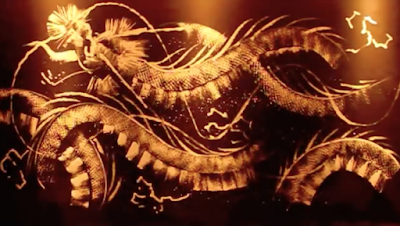
Video of the paining of a golden dragon by Takeshi Sato

When many visualise their thoughts of Japan the first concepts that spring to mind are Toyota or Sony or the Nintendo Wii. And not much seems to have changed in a decade or more. However, in this country, often perceived to be on something of a downhill slope when it comes to the new, Takeshi Sato and his friends are proving everyone would benefit from taking a closer look and see that creativity remains innovative and powerful in Japan. And just like David Bowie there really is Life on Mars. And it's not just sentient, it's overwhelmingly vibrant.


Takeshi Sato creating a new work of art

Saturday, January 14, 2017

Life in Tokyo - Nikaime no Hanashi

And if you're wondering, the title means "the second story" about Life in Tokyo, the second in a series of loosely interconnected monologues around the fascinating existence of living on the ground as a bilingual illiterate. And this one is about taking a photograph. Or actually slightly over 200 one freezingly cold evening in late December. Photography had always been an enjoyable hobby for me, dating so far back we used to use something known as "film" in our cameras. And then my son came along and, somewhat counter-intuitively, I put the camera down and spare time disappeared into the annals of history.

Norie TamuraBut I'd always wanted to learn how to use one of these new wave digital devices and noticing my beautiful Contax RX could now effectively be sold more for spare parts on e-Bay than as a photographic device (shashinki in Japanese) I invested in a  basic digital model and quickly realised how far out to sea I actually was. So lessons were required but these were going to be in Japanese and the learning curve would be fairly horizontal at best. However then, ensconced and bored on a train one day, having missed my lift back to Tokyo (but that's a whole different sea-sick story) into my phone I typed "photography lessons Tokyo English" and up popped a gentleman by the name of Alfie Goodrich, an outstanding photographer who could lead me into the new world, in English. 

The internet is a lifeline to the non-native world but only as a means of finding the solution to a problem (imagine trying to find Alfie by word of mouth). And so we spent the first of what I plan to be many evenings with the beginnings of an understanding of available and flash-light portrait photography, working with the incredibly stunning, and extremely talented, model, Norie Tamura. My point, though, is that language isn't a barrier to life in Japan. As one of my son's teachers once pointed out, a ten year old, with an iPhone, could thrash all the parents from the school combined in a pub quiz. Japan really is open to anyone today, you just need to see the question.

Noire Tamura

Saturday, January 7, 2017

When the children break free

Ever since the year 2000, the second Monday of January has been a special day as each and every twenty year old reaches the age of majority (before 2000 that it was 15 January but that led to conflicts with the Happy Monday Law that automatically moves a national holiday to the following Monday if it happens to fall on a Sunday. Which it did on a fixed date). Although already recognised in law, on this day they become recognised as an adult in the eyes of a culture. 

Morning ceremonies will be held across the country in town halls and schools to congratulate them and wish them well for the future but to also remind them of the responsibility they now hold in their hands. Dating back at least until the Nara Period (most of the 700's) the ceremony of Genpuku (colloquially translated as "to put ones head on") is a time of celebration (though sometimes with a little too much celebration...) for both the young adults coming of age but just as much a moment of pride for parents and family. 

And so everyone will dress in their finest and attend their local ceremony; boys usually in ill-fitting suits looking someone uncomfortable, girls wearing incredibly ornate and beautiful furisode (pronounced "fu-ri-so-day") a long sleeved version of kimono, traditionally denoting the lady remains unmarried. So if you want the most incredible memories of Japan, grab your camera and head into town, it is truly a sight to behold. And congratulations, probably with some hiccups on the way, you've made it to adulthood. Have a wonderful day.


Wednesday, January 4, 2017

Nengajo - knowing you're not forgotten

Japan isn't big on Christmas cards. In fact, unless you actually know where to look (Tokyu Hands or The Loft) you're probably going to miss them entirely. But the jigsaw cards are fun, you can write your message and then break them into dozens of pieces, pop them into an envelope and send it to your friend for re-assembly at their leisure. But the issue is not really one of Japan being a largely non-Christian country and therefor not celebrating Christmas, most Christian countries don't send Christmas cards for that reason; it's just a traditional way to say you're thinking of your friend.

And Japan does that on January 1st. In fact, more than 20% of the total mail despatched each year is delivered on one single day as the national population takes time out to wish each other well. The cards are known as nengajo and will almost always be personalised, whether with a photograph of the family (which year by year you see growing, ageing, learning, leaving the nest or just smiling and saying hello) or with a handwritten note to let you know you're not forgotten in life.

And as you get older the stack of cards grows from a few to often hundreds. I once stayed with a family for New Year in southern Kyushu and their collection required two hands to hold them all. But I have decided to become eco-friendly and make my little contribution to saving the rainforests. The card was prepared with photoshop and Facebooked and emailed. A few however will still be printed and handed personally to some who don't inhabit this digital world. Because they're also my friends and I'm thinking about them too.  

Saturday, December 31, 2016

A Fine and Happy New Year!

It's New Year's Eve and Tokyo is quiet as people have returned to their home towns to be with family. Tonight the country will be sitting in front of the TV watching Kohaku, the annual "Boys vs Girls" (boys in white, girls in red) sing off that has been running for, it would seem, ever. All the favourite singers and talento of the day join in an multi-hour extravaganza of a competition, wrapping up just before midnight as everyone switches over to watch the countdown on Jonny's Pop Show.

But there's an interesting aside for the name of Kohaku. The reason why the girls are in red and the boys are in white is that Kohaku is actually a stylised koi carp which is also red and white. Bred in the 1800's it's now featured in garden ponds the world over and each and everyone can be traced back to a gentleman by the name of Kunizo Hiroi who successfully mated the first pairing to an ornamental fish. But more impressively, single handedly invented the concept of an ornamental fish in its own right.

But as Kohaku closes, the camera will switch to a tolling bell, ringing in the New Year. And that's when everyone changes channel to the Jonny's party. A neighbour of mine, the lead guitar of a band  known as "New Dawn" used to hangout here and we'd have beers on the balcony. He was a really nice guy and I never really knew what he did or who the band were. Until I saw him closing the show as the countdown sounded. I asked him later about why a famous guy like himself would sit and drink a glass with me (of all people) and he said that as I didn't know who he was he just felt like a regular guy. And he liked that. Happy New Year.


Saturday, December 17, 2016

Smile, it's a beautiful day

This happens to be my 500th post on TenguLife, and as such please indulge me a little. Allow me to recount a story from the closing days of December 1991, in the depths of downtown Tokyo, I was in a bar, long since fading into history, when the girl of my dreams walked through the door. And here I am today, all these years later, walking the sights of Tokyo, the two of us still holding hands. And it's a sunny day.

When we met she spoke no English and my Japanese was remarkably close to useless. Luckily her friend who was with her that evening had spent a couple of years in LA and helped us out at the beginning but after that, it was just her, me and a dictionary. Conversations were confusing, slow and difficult but we persevered, sometimes with hilarious consequences as we tripped over each others language and culture.

This was in the days before Google and the mobile phone, the two great facilitators of the modern era. Arranging a date via answer machine was almost always a hit and miss affair, you just had to repeat the time and place three times, hang up and hope. But slowly we figured it out, developing a language the two of us could understand but others, may be not. And now our son is leaving for university. You really can do anything you want to do in life. You just have to try and give it a go. Have a wonderful day.


Friday, December 9, 2016

Winter is Coming

Winter is coming to Japan. Soon the daytime temperature in Tokyo will be hitting low single digits and already snow has fallen in the capital; though admittedly that was the earliest winter wonderland has arrived in nearly sixty years. And this means it's onsen season. Yey! It may sound a little strange to the uninitiated but one of the greatest pleasures in life is to laze in a tub of hot water with friends as the snowflakes falls around you. And Japan is very good at this.

These days there are four essential styles of onsen (hot spring) that are popular with the populace. The international tourist focussed ones tend to require swimsuits but the traditional pools are almost universally au natural as it were though modesty maintained with a handy modesty towel. The classical onsen are segregated allowing your time or relaxation, neck deep in piping hot water, with the guys or girls. Though it has to be said the chatter from the ladie's side tends to be a little (lot) louder than the men's. 

Konyoku, mixed bathing, is actually the traditional variety (it's not inappropriate to bathe, however it is inappropriate to look) but these largely disappeared following western influences over the last century though if you really search around they can still be found, hidden away. And the final version is known as kazokuburo, or family bath. Usually unfrequented by teenagers but younger families or the slightly older will enjoy time together chatting the night away. Japan is more relaxed about spending family time together, a little freaky for a westerner, but just wait for the snowflakes to fall. Winter is coming.